The Lost Way - Chapter 2
The team uncovers an impossible artifact at a 4th-century dig site, but the real mystery begins back in the lab. New chapters published weekly.

I got some great feedback from readers! Among other things, I realized I hadn't described the characters as well as I could have early on. I’ve gone back and retconned Chapter 1 with some new descriptions—the biggest changes are in the first few paragraphs.
If you just want to dig in, read here. I attached some profiles to the end of the chapter as well.
Also? Please tell your friends!
Chapter 2
“I still think we should hit it,” Adam said, taking a sip of beer and sitting down at the work table, “It is a bell after all.”
“We don’t know that,” responded Sara.
They’d left the site with the object shortly after finding it. There wasn’t much else they could do with it in the field. Sara had meticulously documented where they’d found it before Adam secured the trench for the night. They didn’t do anything to disturb the site, but after finding something so unique, they didn’t want any snooping or a rainstorm causing issues. Whatever the artifact was, it was going to upend the history of the site. It would also likely define their careers, assuming they could figure out what it was and why it was hidden in the wall of a bathhouse.
“You will not be striking it,” Nikolas stated flatly. “It is an artifact the likes of which we have never seen. The language suggests it’s 1st-century, but it was found in a wall built during the reign of Theodosius. That’s a three-hundred-year gap...”
Nikolas paused, turning the object around in his hands. His brow crinkled.
Ani continued as he stopped speaking, “It’s Koine Greek. The dialect matches the Pauline Epistles almost perfectly. Krouson ton kodona... Strike the bell.”
“But. It doesn’t...” Nikolas trailed off.
ΚΡΟΥΣΟΝ ΤΟΝ ΚΩΔΩΝΑ ΙΝΑ ΒΟΗΘΗΣΟΜΕΝ read the bell.
“That’s not what it said in the field,” Nikolas continued, his voice full of uncertainty, “I swear I read Omega there, but now it’s Omicron.”
Ani wandered over to take a look. She read the text, “We need to look at the pictures. I remember the Omega, too. Maybe it looked different after we cleaned it better?”
“Can one of you enlighten me?” asked Adam. “I know a lot of science, but I fall short in the differentiating ancient languages department. Omega versus Omicron? They do look similar.”
“They are,” explained Ani, “But in this case, the change makes a difference. It’s part of how we date these sites when someone wasn’t nice enough to leave a coin for us to find. By the 4th century, the language had changed enough that Omicron would have replaced Omega. So now the text actually makes sense in context, assuming the object was made at the time. With the old spelling, I assumed it was a relic that had been kept around for a while.”
“Relic or not, you and I both saw something different just a few hours ago,” Nikolas responded.
Sara had reached her limit. She interjected, “But what the heck is this magnet doing attached to it? In that era, no one had that sort of technology. It pegged out the field magnetometer. This thing should be pulling on our belt buckles, but it isn’t.”
As they argued, Nikolas continued to sit at the table, hunched over to examine the bell. He used a pen light and a magnifying glass to carefully examine each letter. They couldn’t be traditionally engraved; they were too perfect. The technology to make such even marks on the bronze would not have existed at the time. He tried his best to ignore that and focus on the words, rolling the idea over in his mind that the sun had indeed tricked him.
“She’s got a point,” Adam mused. He took the object from Nikolas, pulled out his pocket knife, and brought it towards the artifact to see if it would attract the steel blade. It didn’t waver in the slightest.
Sara snatched it from him, “Are you freaking kidding me? Have you ever seen the videos of MRI machines? That’s the kind of magnetism we’re talking about. Rip earrings out level. We have tools for this stuff.”
Adam dropped the knife and feigned checking his chest as if he had nipple rings that might be pulled out. Ani couldn’t help but laugh at the tiny brunette taking an object from the tall, broad figure of Adam.
“Is everything a joke to you?” asked Sara, frustrated. She placed the object safely in the middle of the table.
“It’s a defense mechanism from his inherent academic inferiority disorder. He left the ivory tower to follow a girl, and he’s been doing this schtick ever since,” Ani responded, trying to calm Sara.
Adam pointed an accusatory finger at her, but the grin twitching at the corner of his mouth gave him away. He set down his beer and leaned his chin on his elbows, looking at the two women.
“Sorry. Sara. Ani’s got me dead to rights. Either way, tell me the massacre story again? Maybe there’s something,” Adam mused, looking at the object on the table.
Ani began, “A famous circus charioteer from the hippodrome was arrested, a real crowd favorite. When the local Roman commander refused to release him for the andupcoming races, the city erupted and lynched the commander and several other officials. The Emperor Theodosius sent troops in and trapped citizens in the hippodrome on the guise that there would be a race. The soldiers then killed every man, woman, and child in attendance. This was seen at the time as an overreach and even drew the ire of Saint Ambrose, who told the emperor he couldn’t be a part of the church again until he did penance, which he did.”
“That was a huge moment,” she continued, “It is essentially when the church gained power over the empire. The Western World wouldn’t see another secular government for a millennium.”
Adam set his beer down with a soft thud, his casual demeanor slipping for a second as the brutal imagery hit. Nikolas just stared at the table, nodding slowly, intimately familiar with the dark history.
“And what does that have to do with this bathhouse?” Asked Adam.
“Ten years earlier, the Edicts of Thessalonica had enforced a strict interpretation of Christian dogma, demanding the removal of pagan iconography. Legend says the emperor sent the legion not only to punish the citizens, but also to ‘purify’”—she made quote marks with her fingers—”the city. This bathhouse was adjacent to the hippodrome and would’ve been one of the last remaining holdouts. There’s no Christian iconography on this object, which fits the timeline perfectly. Maybe a fringe group was using its weird properties to simulate pagan miracles?”
Ani took a breath and bobbed her head back and forth. She’d pulled her unruly curls into a ponytail that flopped back and forth as she did. She leaned in, her voice dropping. “Because the story goes that there was a group here called the ‘Lost Way’ that rejected the strict interpretation of Paul’s letters and stuck strictly to the gospel message of pacifism. The church allegedly used the chaos of the larger massacre to wipe them out. Some versions say they were hidden members of the elite; others say they were just servants working in the bathhouse. But every account ends the same way: a detachment of soldiers entered this building and slaughtered everyone inside.”
She shrugged, trying to lighten the mood. “There are still a lot of superstitions about the ruins. Locals claim they can smell woodsmoke and essential oils wafting out of the stones.”
“It also makes a fun story to keep kids out of the ruins and attracts amateurs to dig for fortune and buy beer in the tavern,” joked Adam while tipping his beer at Ani.
Ani countered, “Myths are always based on fact, Adam.”
“Yes, but a major confrontation between church and state was a cover to wipe out a pacifist network? Not likely,” Adam said. “ That’s some Dan Brown stuff. I love a good yarn as much as the next guy, but that seems like a stretch.”
“Not a front, a side mission,” Ani countered, leaning against the table and crossing her arms.
“So we’re doing ancient holy side missions now?” Adam smirked, looking up at her from his seat.
Ani smiled, “Some of us understand there’s more to the world than what you can see and wrap your hands around.”
As they talked, Sara walked over with two rugged, plastic cases.
“I didn’t know you were into handguns,” said Adam.
“Ha ha. They’re not handguns. They’re sensors.” Sara said, taking the first tool out. She pulled out a device attached to a long black wand.
Adam and Ani watched on as Nikolas paced. She set down the first tool and took out a gray device with a distinct handle and barrel from the next box.
“It’s a RAY GUN!” Shouted Adam.
“It is not a ray gun,” she sighed, “It’s a handheld XRF spectrometer. It’ll tell us the exact composition of the metals in the object.”
He sighed, “Sara, I’m just trying to lighten the mood. But you have to admit, it looks like a sci-fi blaster.”
“Do you want to get shot with an X-Ray device?” she said, pointing it at him with a raised eyebrow, the tension between the two finally breaking.
“I’d prefer not,” Adam held his hands up.
Sara pointed the device at the dome of the ‘bell’ as they’d taken to calling it. The device’s cooling fan whirred loudly in the sudden quiet as the team sat, waiting for the results. A high-intensity blink of light flashed against the green patina of the bronze. She stared at the results, scrolling on her tablet.
“88% Copper, 12% tin. Boring old bronze,” she said, re-aiming the device at the bottom magnet portion. Sara stared at the scrolling elements on her tablet. “It’s reading Neodymium? That can’t be right.”
She scanned it again. “Nikolas, somebody’s screwing with us. We need to bag this, seal it, and get the Chair on the phone. If this gets out, we’ll have the Greek Ministry of Culture banning the university from digging here ever again.”
Adam interjected, “Wait a minute, Sara. I’ve been digging for fifteen years, and the layers down there were pristine. We saw every layer of soil we should have, top to bottom, with nothing disturbed.”
“I don’t know what to tell you, Adam. This material didn’t exist until the Reagan administration,” Sara responded, her voice beginning to quaver, “You might like to thumb your nose at academics, but some of us are just starting our careers.”
Ani stepped in, “No one is going to publish anything about this. Sara, it’s ok. This all stays in the room for now.”
“It changed. It must have,” interjected Nikolas.
The three others stopped and looked at the tall, glasses-clad man.
“The orthography changed. It must have,” Nikolas said, his tone leaving no room for argument. “I don’t misread languages in this period like that, and neither does Ani. It struck me in the trench because finding a 1st-century object in that context, while not impossible, suggests it was important enough to keep for three hundred years and then be sealed up in a wall. Now, all of a sudden, it’s a perfect linguistic fit for the site.”
“Nik, it was hot out there. Easily 40C or whatever the equivalent of a hundred Fahrenheit is.”
“Nikolas. And it’s 37C.”
Adam sighed, “Nikolas, it was hot out there. The artifact was dirty. The letters are different, but they aren’t that different.”
“He’s right,” whispered Ani, “I remember it too. The change in letter changes the era of language.”
Sara interjected, “Just check the photos. We must have dozens, but this is a silly argument.”
The team all pulled out their various devices and began scrutinizing the photos. The room went quiet for a few minutes as the scientists scrolled and zoomed. Nikolas took off his glasses, squinting at the glowing screen of his phone, looking perturbed.
“See? Omicron,” said Adam. “Honestly, guys, I know that Classicists love arguing over what letter something is and what it means, but it’s the difference between a circle and an almost circle with two serifs on the bottom.”
“It was an Omega. I’d swear it,” said Nikolas.
Ani held up her hand. “I remember it too. The whole point of arguing over the difference is dating and meaning. I’m not Nikolas with Greek dialects, but I distinctly remember taking note that it would have been older than the room we’re excavating. It might sound crazy, but I’d already started writing a paper about this previously unknown holy relic.”
“Berenstein, Berenstain,” Adam shrugged.
“What does that mean?” Nikolas asked, looking puzzled.
Adam picked up his beer, grinning and taking a sip. He sat down on one of the tables before continuing.
“Have you ever heard of the Mandela Effect? Because, do I have an internet rabbit hole for you, my friend.”
Nikolas pinched the top of his nose. “Now is not the time for your American trivia.”
“You two must be the worst friends ever,” Ani laughed as she spoke. “I still have trouble understanding how this friendship ever came to be.”
“With great difficulty,” said Nikolas dryly.
“It’s tradition, and Nikolas needs me. His mom said so.”
Nikolas shook his head. “Need is not the word I’d use, and you’ve never met my mother.”
Adam smirked at him. “I’m here in Greece. Maybe it’s time you brought your long-lost brother home for a visit!”
Sara, meanwhile, had pulled out the second sensor, a handheld magnetometer that measured the magnetic force being produced by an object. In theory, the device would be able to measure the actual force, but there was something wrong. Either the device wasn’t working, or she was crazy. The display read zero. Deciding it was time to let physical science step in, she walked over to a cabinet and retrieved a bottle of iron filings.
Around her, the team continued their banter. She had to admit, bringing Adam on this summer gave them a real-world boost as far as technical excavation went, but it heavily highlighted that she was the new kid on the block with this crew. Stifling a sigh, she sprinkled the filings near the object, where they fell into a random pile.
Flustered, she went back to the shelf to retrieve a small stone—a piece of magnetite used to calibrate her sensor. She placed the magnetite on the table about a meter away from the artifact. She slowly brought it closer and closer, keeping a loose hold, waiting for it to interact with the artifact’s magnetic field.
Except it didn’t interact. Sara pushed it all the way against the object until there was a sharp click as the stone hit the metal. She frowned, lifting the magnetite and tapping it again against the bronze gently, as if she could force it to cooperate. Nothing.
“That just can’t be,” she said, puzzled. “It just can’t.”
“What can’t?” asked Adam.
“It’s not magnetic anymore,” Sara responded.
“That’s absurd,” said Nikolas, “A magnetized object that isn’t being powered by an outside force would never lose that level of magnetism so quickly.”
“What can I say? It just did.”
The ridiculous nature of the object grated on Sara. Magnetism was a property of the material’s atomic structure. Objects didn’t just ‘lose’ it like a battery charge unless you hit the Curie point, and she was pretty sure her hands weren’t melting away.
She picked up the filings again, waving the bottle over the artifact several times. Nothing. Is it a shielded field? she wondered. Some kind of Flux Compression? No, that would require a power source and a coil. The object was bronze and steel, not much more than purified rocks. Rocks didn’t have ‘on’ and ‘off’ switches.
TANG!
The whole team looked at Ani, who had just hit the bronze bell of the artifact with a tuning fork. The tone was flat and off-key, like a cracked bell, dying the instant she struck it.
Ani dropped the fork immediately, grabbing her arm. “Ow, goddamnit, that stings,” she gasped. There was a strong tingle in her hand that lingered, almost like the resonance was in her arm instead of the bell.
Sara yelled in surprise while Nikolas stood dumbstruck, mouth agape.
Adam smirked. “She followed the directions!”
“But... what if you broke it?!? And why do you carry that around?” Sara exclaimed.
Ani looked at the object. Bronze like that should have reverberated for several seconds. This didn’t. Sara had a good point.
“Maybe it is broken already,” said Ani, shaking her hand out. The pain was like a terrible funnybone strike. “Whatever it is, it defies logic. I feel like it rang me as opposed to the other way around. And as for the tuning fork, a girl never knows when she needs to assess the pitch of something.”
She continued to flex her fingers in and out of a fist. “Besides, let’s think about this whole thing for a minute. This artifact, or object, or hoax, whatever we want to call it, makes no sense. You said it yourself, Sara, this thing is so odd that it could either be the find of the century or the Piltdown man. I want to do more tests before we tell anyone. This one was… ill-advised. As of right now, the only thing anyone but us knows is that we were doing a routine excavation to follow up on an anomaly.”
“But you hit it… with a tuning fork?!” Sara exclaimed.
“I said it was ill-advised. I paid a price for it.”
“She hit it with a tuning fork,” Nikolas mumbled, looking completely dumbfounded.
Adam stepped in. “Agreed. We need a plan. In my mind, we go dig the rest of the room out. Whether the hidden space in the wall had this in it or not, it warrants excavating the rest of the room to look for other hiding places. We wouldn’t typically see spaces inside the walls from mag results.”
“Correct,” Nikolas said. “Given all the unexpected discoveries today, we need to see what else was in the room. Our permit allows us to dig in the vicinity for another few weeks. Adam is one of the best excavators in the field, and Sara can do additional scans as we go.”
“Nikolas, how about you and I hit the archives? An object like this must have some reference,” Ani suggested.
He nodded.
“And what about the artifact?” exclaimed an exasperated Sara. “Do you suggest we just throw it on the shelf?”
“Nope,” Adam said, opening a drawer and dropping the object into it. “I’m putting it in the one place no one will look - the junk drawer.”
The team milled about for a few more minutes before heading out of the lab. Ani was the last one to make her way out and looked back at the drawer as if called to it. She shook her hand out one last time and turned off the lights.
Inside the drawer, the device sat. The loose paperclips, keys, and screws around it did not. Slowly, they began to slide and rotate, aligning themselves in the same direction.
And… Finally… The Promised Character Profiles
Adam The pragmatic, linebacker-sized American field director. A veteran of the high-paying private sector, he has zero patience for academic stuffiness and treats digging like a sport. He’s the physical anchor of the operation, quick to use dry humor to diffuse tension, and famous for defending the ancient, dirt-licking tradition of field testing artifacts. To Adam, if you can’t dig it up or map it, it’s just chasing ghosts.
Nikolas The classic, hyper-meticulous scholar. Though his passport says Greek, his Oxford education and rigid, black-and-white academic persona make him stand out in the dirt. He is intensely protective of antiquities, unyielding in his methodology, and absolutely loathes being called “Nik.” He deals strictly in measurable, documented evidence—leaving the wild theories to the rest of the crew.
Ani The brilliant cultural historian and the true narrative soul of the site. Larger-than-life, fiercely sharp, and possessing a deep intuition for ancient languages, she is always ready to let local lore and myth lead the way. She shares a protective, twin-sibling dynamic with Adam, but her deep obsession with ancient texts puts her in a constant, playful battle with Nikolas over the “meaning of life” hidden in the history.
Sara The uptight, high-strung data scientist and physics grad student. Dragged out of her clean tech labs and into the mud to test her experimental remote sensing algorithms, she is protective of her equipment and deeply worried about her academic reputation. Sara deals exclusively in high-resolution data streams and rational logic, making her the most visibly panicked when the archaeology team starts talking about hitting impossible artifacts with rock hammers.
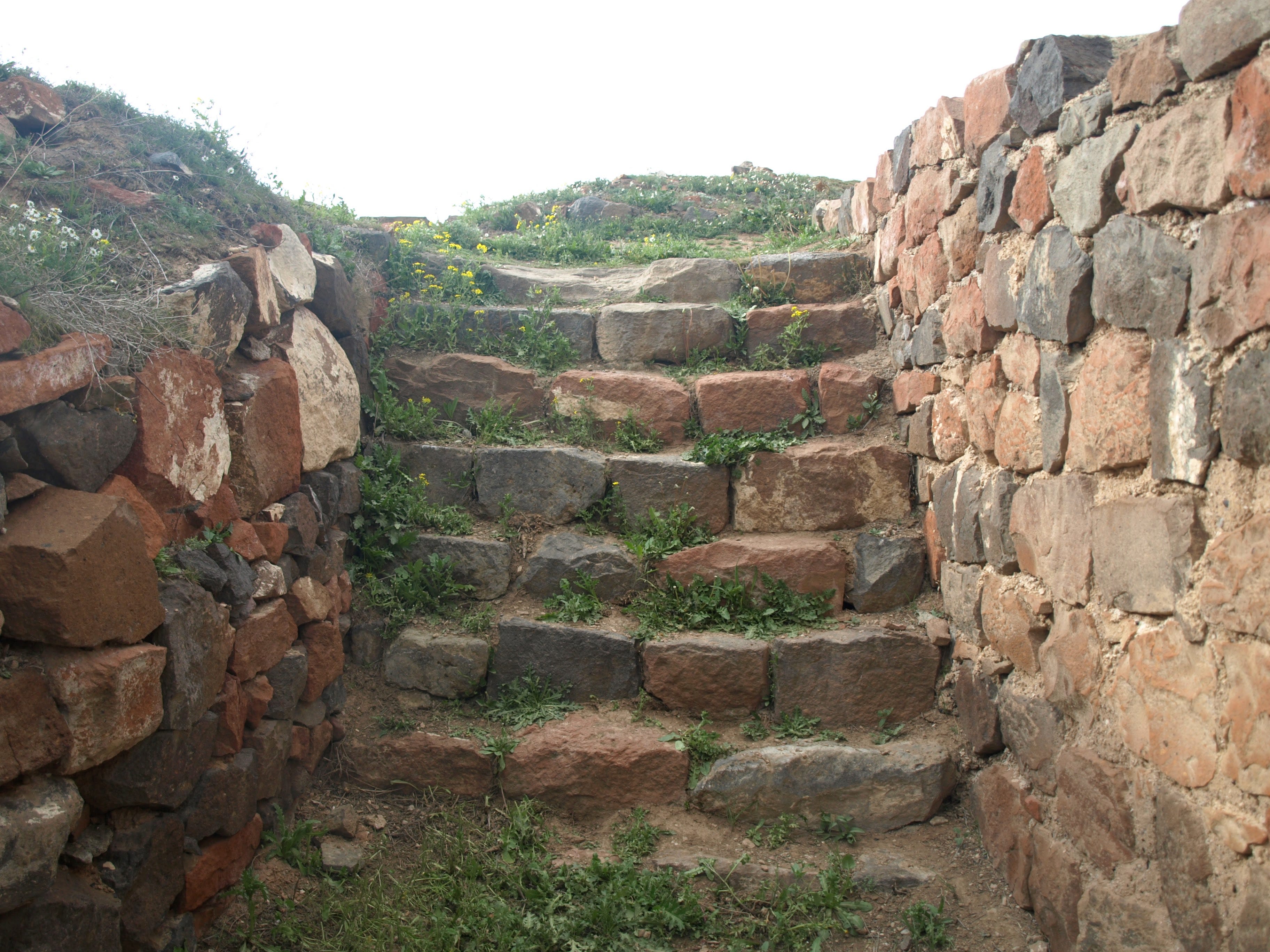
Bonus: An image of a stairwell at Erebuni Fortress. It’s waaay older than 390, but it makes the tag for the post look nice.